VOO vs VTI: What Is Actually Different Between the S&P 500 and the Total Market?

Alice
November 26, 2026 · 6 min read
VOO and VTI are two of the most widely held ETFs in the US. Both come from Vanguard. Both charge an expense ratio of 0.03%. Their biggest holdings are almost the same companies, and on most days they move almost in lockstep.
So why do investors keep asking which one to pick? Mostly because the difference between them is small and easy to miss. This guide lays out what each fund holds, where they overlap, and what to check in your own portfolio before you compare them.
This article doesn't recommend either fund. It explains the differences so you can judge for yourself.
Start with what you already own. If you hold individual stocks as well as an index fund, the fund may be adding more of the same names. Sign up for Bobby, link your RockFlow account, and see how concentrated your portfolio is before you compare funds.
What each fund holds
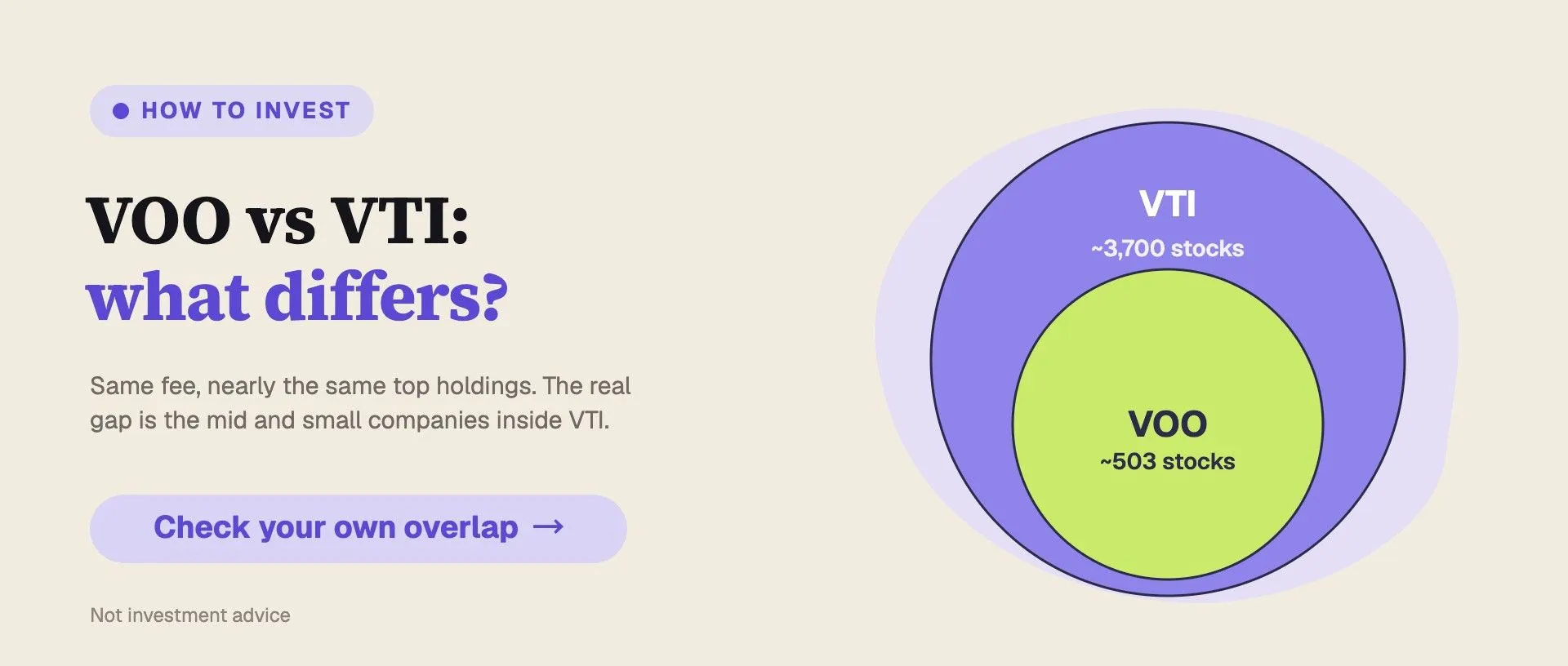
VOO tracks the S&P 500, an index of about 500 large US companies chosen by a committee at S&P Dow Jones Indices. As of May 31, 2026, it held roughly 503 stocks, according to etf.com.
VTI tracks the CRSP US Total Market Index, which aims to cover almost the whole US stock market. It held about 3,700 stocks on the same date. Around 17% of it sits in mid-sized companies and about 11% in small ones, so roughly 28% of VTI is outside the large-cap group that makes up the S&P 500.
The two funds side by side
| VOO | VTI | |
|---|---|---|
| Index tracked | S&P 500 | CRSP US Total Market |
| Number of stocks | About 503 | About 3,700 |
| Mid-cap share | None separately | About 17% |
| Small-cap share | None | About 11% |
| Expense ratio | 0.03% | 0.03% |
| Top holdings | Nearly the same large companies | Nearly the same large companies |
Holdings and cap-size figures as of May 31, 2026, from etf.com. Check Vanguard's fund pages for current numbers.
Compare the funds with your own list. Sign up for Bobby, link your RockFlow account, and check which of your holdings sit in the same big names.
Why they move almost the same
The largest companies in the US market make up most of both funds' value. A handful of mega-cap stocks sit at the top of both lists, and a fund that holds 3,700 stocks still gets most of its return from the same few hundred big ones.
etf.com puts the daily correlation between the two at nearly 1.0, and says the gap in 10-year annualized returns has rarely exceeded 0.5 percentage points, and is often 0.1 to 0.2 points. Past returns don't predict future ones, but the pattern shows how closely the two funds track each other.
Where a difference could still show up
The 28% in mid- and small-sized companies is the real difference. When smaller companies do better or worse than the largest ones, VTI will drift slightly away from VOO. Smaller companies can also swing more in price, though at about 11% of VTI the effect on the whole fund is limited.
The other difference is selection. The S&P 500 has eligibility rules and a committee. The total market index has no such step and includes nearly every listed US company. Neither approach is better by default. They are different ways of drawing the same market.
Questions to ask about your own portfolio
The more useful comparison is often not VOO against VTI, but either one against everything else you hold.
- Do you already own individual stocks that sit at the top of these funds? If you hold a large tech stock directly and also hold a fund, that name is counted twice. We wrote about this kind of overlap in our piece on AI exposure.
- Do you hold both funds? Almost every stock in VOO is also in VTI, so holding both adds little new coverage.
- How much do you want in smaller companies? That is the one choice the two funds actually differ on.
If you are new to reading fund terms, our guide to investing basics covers the vocabulary used above.
Checking your overlap in Bobby
If your holdings are in a RockFlow account, Bobby can read them and show how concentrated your portfolio is. That turns the overlap question above into a quick check instead of a spreadsheet exercise. To get started, download the RockFlow app and open an account, then sign up at bobby.ai and link the account.
Fund questions tend to come up when the market is moving, such as a big earnings week for the largest companies or a sharp one-day drop. Those are good moments to look at how much of your portfolio sits in the same few names. Bobby can pull up quotes, earnings and news for the companies you hold, so you can see which events touch what you own. It shows information; it doesn't tell you what to buy or sell.
FAQ
Which is better, VOO or VTI? Neither is better in general. They cost the same and hold mostly the same stocks. The difference is whether you want the extra mid- and small-cap exposure VTI includes.
Can I hold both VOO and VTI? You can, but most of what VOO holds is already inside VTI, so you gain little extra diversification.
Is VTI riskier because it holds small companies? Smaller companies can be more volatile, but they make up about 11% of VTI, so the effect on the whole fund is limited.
Do the two funds have different fees? No. Both have an expense ratio of 0.03%.
What is the difference between an S&P 500 ETF and a total market ETF? An S&P 500 ETF such as VOO holds about 500 large companies. A total market ETF such as VTI also holds mid- and small-sized companies, about 3,700 stocks in all. In a VTI vs VOO comparison, that extra 28% is the main difference.
Before you choose, look at the whole picture. Sign up for Bobby and link your RockFlow account to see how your holdings are spread across companies and themes.
Fund data as of May 31, 2026, from etf.com. Figures change; verify on the issuer's website.
For informational purposes only; not investment advice. Investing involves risk, including possible loss of principal. Past performance does not guarantee future results. Fund details change over time; verify them with the fund provider before making a decision.
Related Content
Anthropic IPO: How Much of Your Portfolio Is Already in AI?