Netflix's Century Gamble: Did It Buy HBO's Soul or Hollywood's Curse?
RockFlow Shayne
December 12, 2025 · 12 min read
[图片]
Key points:
- Netflix's $72 billion acquisition of Warner Bros. Discovery (WBD) marks the entry of the Streaming Media industry into an era of profit consolidation and oligopoly. The core logic of this deal is that Netflix, leveraging its global distribution scale, will completely address its own IP weakness and incorporate scarce HBO assets such as the DC Universe and Harry Potter in one fell swoop.
- The structure of this transaction is complex, isolating Warner's sunset businesses through "spin-off + acquisition" and achieving tax optimization. However, Netflix's new debt of $59 billion has brought significant financial exposure. Meanwhile, anti-trust reviews and Paramount's hostile interference have increased external uncertainties. The conflict between Netflix's algorithmic culture and HBO's creative autonomy is a fundamental contradiction, and any compromise could lead Netflix to repeat the failures of technology companies' acquisitions of traditional media.
- If the integration is successful, Netflix will achieve content synergy, strengthen its pricing power, and accelerate IP monetization. However, high returns come with high risks. Investors must closely monitor the realization of free cash flow (FCF) and the stability of HBO's leadership, which are key to assessing whether Netflix can avoid the curse of history. This grab for the power core of Hollywood by the tech giant will either help Netflix reach the pinnacle of global entertainment or burden it with heavy debt.
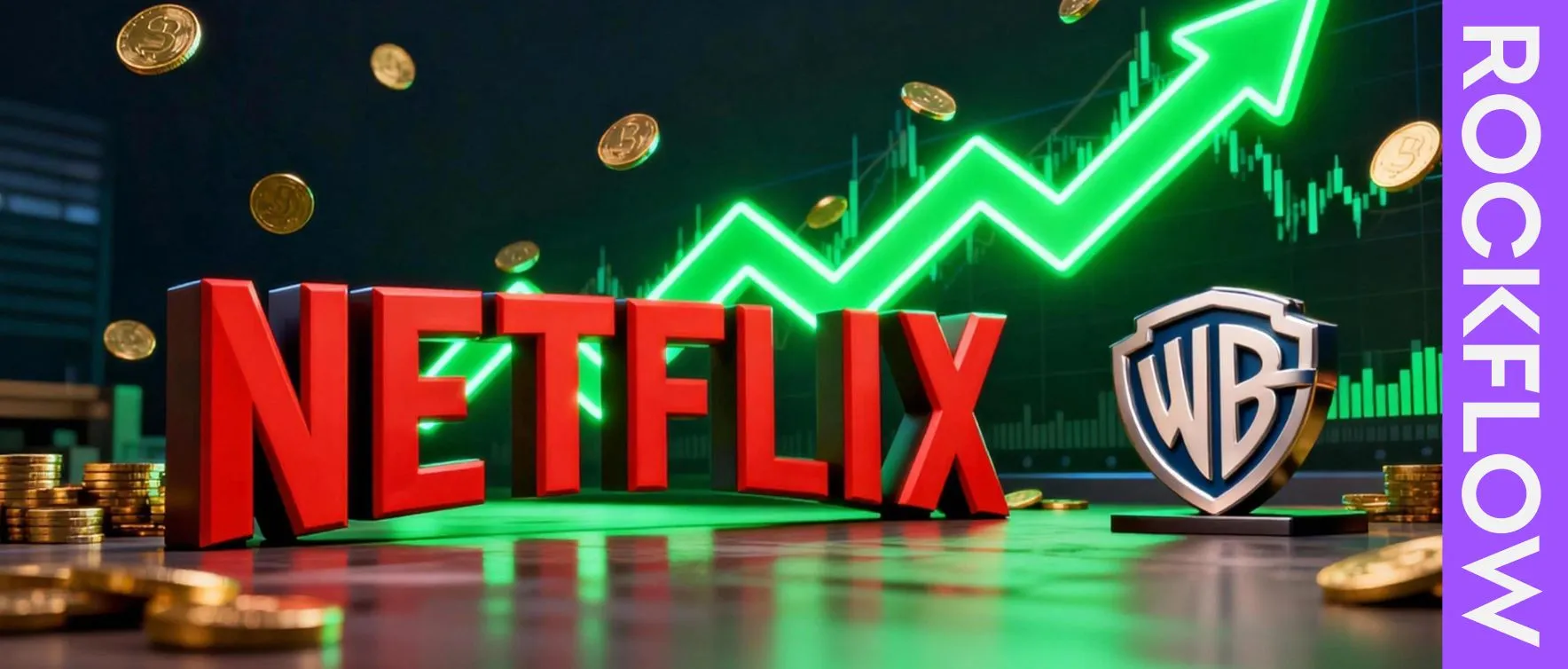
Netflix's acquisition of Warner Bros. Discovery's (WBD) core film and television studios and streaming media assets for an enterprise value of approximately $82.7 billion marks the official transition of the streaming media industry from the era of "content arms race" to the era of "profit consolidation and oligopoly".
RockFlow's investment research team believes that the core logic of this transaction is that Netflix uses its global distribution scale to compensate for its weakness in IP, thereby establishing its position as a vertically integrated super oligarch in the entertainment industry.
Despite the complex deal structure (involving $59 billion in new debt and a hefty $5.8 billion termination fee), and facing stringent anti-trust reviews and significant risks of cultural integration, the potential rewards of its success are substantial: it will kickstart the IP flywheel, achieve synergies, and at the same time, accelerate Netflix's progress towards becoming a trillion-dollar market-cap entertainment giant.
Why does Netflix have to acquire Warner?
Netflix's acquisition of WBD is not only a dual response to the trends in the Streaming Media industry and its own strategic shortcomings but also a complete victory of the scale advantage of the internet over content scarcity.
The evolution of the Streaming Media industry is a classic story of "technological disruption." The distribution network of the Internet has delivered a dimensionality-reducing blow to the traditional Hollywood physical distribution models (theaters, cable TV) in terms of scale and marginal cost.
After the Paramount Decision in 1948, Hollywood was forced to separate production from publishing. However, the emergence of Netflix, leveraging its algorithm-driven global network, has re-established full vertical integration of production and publishing. In the era of publishing constrained by physical space, content scarcity was king. But in the internet age, content aggregators (such as Netflix) have gained overwhelming advantages through excellent User Experience and algorithmic screening.
Netflix has won the victory, proving that the scale of distribution channels (aggregators) is more scalable than the exclusivity of content production (studios). This acquisition of WBD is Netflix's ultimate strategic grab for the most valuable asset in the industry it has severely hit—intellectual property.
Netflix's long-term success has been built on its global distribution network and algorithmic recommendations, but its original IP lacks the cultural depth and derivative value that can be "passed down through generations," presenting structural flaws.
The appeal of WBD's assets lies precisely here: it has media memories and scarcity accumulated over a century, including the DC Universe, Harry Potter, The Lord of the Rings, and classic HBO series (such as Game of Thrones and The Sopranos). These assets are something that Netflix could never create from scratch.
Through acquisitions, Netflix has addressed its long-standing anxiety over the lack of ecosystem flywheel support, enabling it to compete with ecosystem giants such as Amazon, Apple, and Disney (which has acquired a large number of IPs through the acquisition of Fox) in the long term.
[图片]
Given that the underlying logic of current industry consolidation is the urgent demand of capital for profitability and free cash flow (FCF), Streaming Media is moving towards the end state of a market monopolized by a few global entertainment platforms.
Netflix's deal structure is considered quite "perfect," as it achieves risk isolation and strategic focus through a sophisticated mechanism of "spin-off + acquisition":
Achieve scale economy: Cut redundant SG&A and technology spending to enhance operating leverage. Reduce long-term content costs: By internalizing IP licensing and production processes, there is no longer a need to pay high licensing fees to third parties. Divesting Declining Businesses: By acquiring only WBD's "IP Engine" and Streaming Media business while divesting the declining cable TV networks (such as CNN and TNT), it has avoided the risks associated with sunset assets.
Netflix's acquisition of WBD's assets at a high multiple premium of 20x EBITDA (compared to Disney's 12x) may seem expensive, but its core value lies in the discounting of future synergies and derivative value.
RockFlow's investment research team believes that what it is paying a premium for are "control rights" and "global scale distribution rights". With full control over the IP, Netflix will be able to maximize the lifecycle value of these assets through its global network of over 300 million members.
The complexity of the trading mechanism and political wrangling in Washington
Netflix's acquisition of WBD is a complex capital operation involving high leverage, complex tax avoidance design, external competition, and political maneuvering.
The deal structure reached between Netflix and WBD is extremely complex, with its fundamental purposes being tax optimization and risk isolation. WBD will spin off its linear network business into a brand-new, publicly listed, independent company named Discovery Global. Netflix will only acquire the remaining entities, achieved through "Holding Company merger" and "spin-off".
This design ensures that Netflix does not have to bear the risk of decline in WBD's cable TV business and helps WBD executives avoid most stock compensation taxes. This indicates that Netflix has optimized financial exposure and transaction structure to the fullest extent when conducting such large-scale mergers and acquisitions.
However, immediately after the deal was announced, Paramount Pictures launched a $108 billion hostile takeover bid for the entire WBD company, adding drama to this integration.
Netflix's previously set hefty termination fee of $5.8 billion (8% of the equity value of the transaction) is one of the highest termination fees in the history of mergers and acquisitions. This clause strongly locked in the WBD board and made it extremely costly for competitors such as Paramount to make another bid (as WBD would need to pay a reverse termination fee of $2.8 billion if it accepts another bid).
In this transaction, Anti-Trust review will be the biggest uncertainty. The combination of Netflix + WBD will form a super oligopoly in content production, publishing, and advertising markets. It is estimated that if the acquisition is completed, Netflix will control 45-50% of the US paid Streaming Media market.
This is naturally not what regulators would like to see, so the Federal Trade Commission (FTC) will rigorously review this transaction. Netflix's view is that its vertically integrated model (the combination of streaming media and studios) is more reasonable than horizontal mergers among competitors.
[图片]
However, Paramount's team's active lobbying in Washington and accusations of political favoritism surrounding the Trump administration have filled the regulatory approval process with uncertainty.
The RockFlow research team believes that final approval will depend on regulators weighing Market Concentration, content licensing leverage, and consumer interests.
In addition, investors are also very concerned about Netflix's plan to borrow $59 billion to fund the acquisition, which will take its leverage ratio from near zero to about 3 times, significantly increasing the pressure on its balance sheet.
Netflix must ensure that WBD's assets can quickly generate the expected FCF and $20- 3 billion synergy effect to offset interest expenses and avoid the risk of a credit rating downgrade caused by a leverage ratio soaring to 4 times due to out-of-control integration costs.
Netflix "devours" Hollywood's execution risk
The ultimate challenge of this acquisition lies in execution and cultural integration. Netflix needs to integrate its Silicon Valley culture of "Data drive, algorithm optimization" with the Hollywood tradition of "IP priority, creative autonomy" under WBD, and the two are fundamentally contradictory.
Netflix's past philosophy was to reject theatrical windows, while WBD publishes a large number of mainstream theatrical films each year and adheres to traditional windows. Netflix CEO Ted Sarandos once called traditional theatrical windows "outdated" and stated that Netflix's "primary goal is to provide members with premiere movies." However, to ensure the success of this acquisition, Netflix has promised that WBD's movies will continue to be released as planned.
Currently, the market believes that the most likely outcome is a "slow and painful compromise": the theatrical window period will be significantly shortened, making it a supplement to streaming media rather than the primary source of revenue. The potential risk of this approach is that it may alienate theaters and anger Netflix subscribers who want to watch immediately, ultimately causing losses to both parties.
On the other hand, HBO's brand value is built on its "gold standard" content and respect for creative autonomy. If Netflix were to attempt to impose its algorithm optimization and data-driven decision-making, it would be catastrophic.
Netflix management has yet to clarify whether HBO will continue to operate as an independent service. If Netflix attempts to impose "Data-driven directives" on the HBO creative team, the best content talent will "flee in droves," thus ruining this core asset. Netflix must find a balance that allows HBO to remain HBO while leveraging Netflix's distribution system and marketing machine.
Meanwhile, WBD Television is still currently producing content for Netflix's competitors (such as Apple TV+ and Amazon Prime). Netflix has committed to maintaining this business.
This brings obvious conflicts. Once WBD becomes Netflix's Wholly-Owned Subsidiary, its internal Incentive Mechanism will become ineffective - it lacks the motivation to "sell the best projects to the highest bidder". This contradiction will ultimately lead to the shrinkage of third-party production business and direct more high-quality content to the Netflix platform, thereby affecting WBD's revenue structure.
Historically, most cases of technology companies acquiring traditional media assets (such as AOL-Time Warner) have ended in failure. Netflix must avoid repeating the same mistakes and integrate WBD's dreams into its algorithmic machinery without undermining its creative spirit.
[图片]
If the integration fails, this will be the fourth time Hollywood has witnessed the same scenario: a technology company acquires traditional media assets, underestimates cultural integration, imposes the wrong operating model, leading to talent drain, missed synergies, and damage to shareowner value.
Conclusion
The acquisition of WBD marks Netflix's official transformation from a streaming media service provider to a full stack entertainment group. Netflix will gain an unparalleled content library and global distribution network, enabling it to: Gain pricing power: With the most comprehensive content library in the market, increase ARPU and membership retention rate. Boosting Advertising Revenue: The increase in viewing share (expected to exceed 10%) helps it gain stronger bargaining power in ad-supported packages. Achieve operating leverage: It is expected to return to the track of steadily increasing profit margins by the third year.
RockFlow's investment research team believes that although Netflix's short-term stock price has declined due to huge debt and integration risks, it is leveraging the acquired IP to build a more imaginative future.
Currently, Netflix House (already opened in Philadelphia and Dallas, with plans for Las Vegas) is the starting point for Netflix's entry into the theme park and merchandise retail sectors. Netflix is "rebuilding Hollywood's oldest power operation model": by combining its own IP with its own distribution channels (Streaming Media platform + Netflix House theaters), it is constructing a vertically integrated "closed-loop ecosystem".
Overall, Netflix's acquisition is a high-risk, high-reward bet. In essence, it is a tech giant's grab for the traditional power core of Hollywood.
If Netflix can successfully overcome the significant challenges of $59 billion in debt and cultural integration and smoothly achieve synergies, it will become an undisputed global entertainment giant, solidifying its long-term market leadership. Conversely, if the integration fails, this deal could become the heaviest burden in Netflix's history.
Related Content